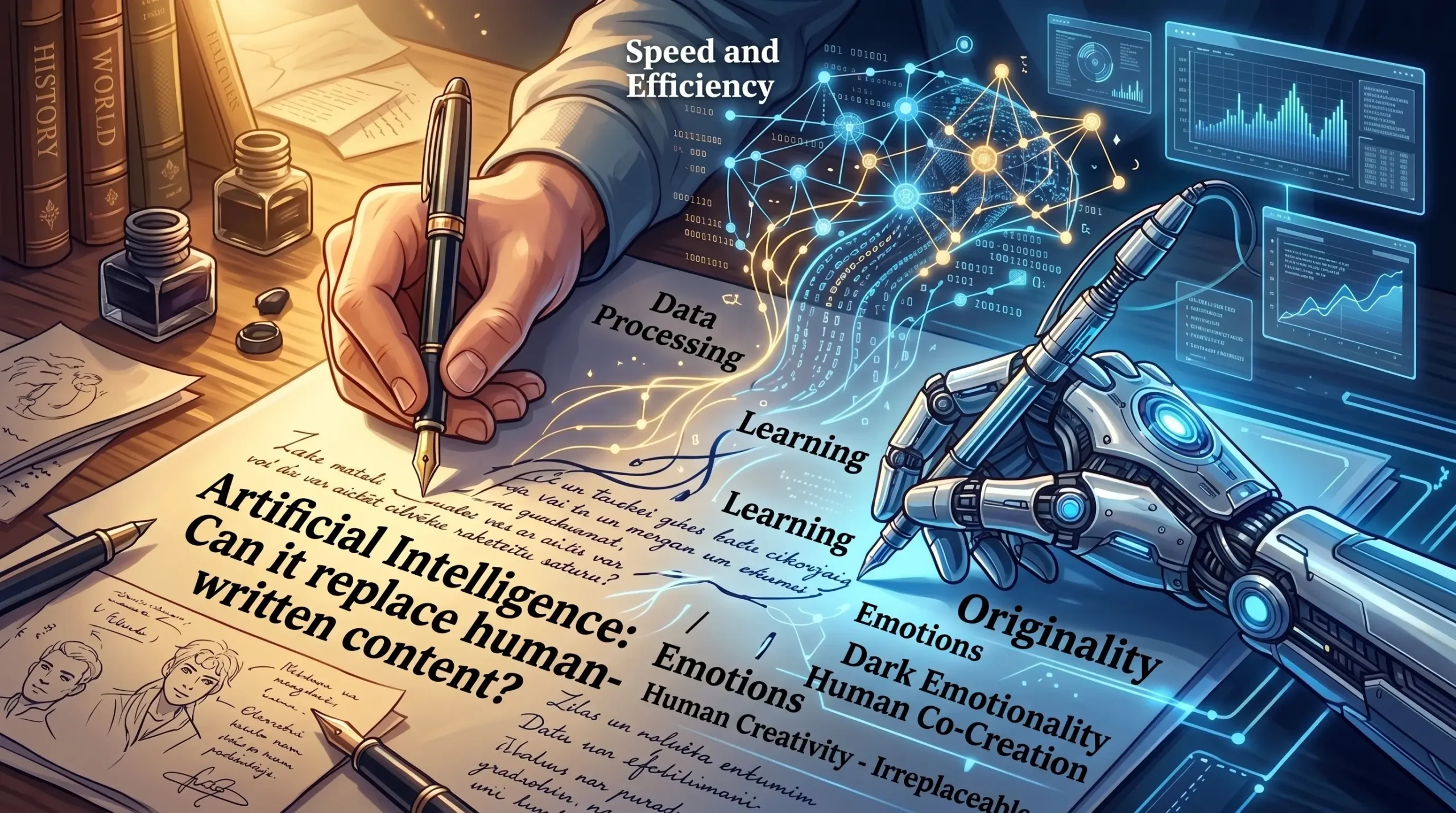
In this age of modern technology, there is an increasingly frequent debate about whether artificial intelligence (AI) can completely replace human-created content, particularly in the field of writing. AI is already capable of generating various types of text, but does that mean that human creativity no longer matters?
The benefits of artificial intelligence
- SPEED AND EFFICIENCY – generates text in seconds, enabling you to quickly create large amounts of content, saving time and resources.
- COST-EFFECTIVENESS – for businesses, using AI is cost-effective as it reduces the need to employ content creators and editors.
- CONSISTENCY – ensures a consistent style and terminology, which are important in brand and media content creation.
- DATA PROCESSING – the ability to analyse vast amounts of data and create content based on real facts, statistics and trends, as well as to make this content useful for research and business analysis.
- AUTOMATION – creates and adapts content, such as product descriptions and news summaries, thereby freeing people from routine tasks.
The shortcomings of artificial intelligence
- EMOTIONS – there is a lack of human empathy and the emotional depth required to craft stories and create inspiring content.
- ORIGINALITY – generates content based on previous data, but is unable to produce entirely new, unique ideas.
- CONTEXT – often fails to grasp complex cultural and social contexts, and may also result in inaccurate content.
- MORALS AND ETHICS – Generated content may give rise to issues regarding copyright and the spread of disinformation, and such content may not be ethical or in line with social norms.
- IMPROVISATION – a lack of the ability to come up with creative, spontaneous and unpredictable solutions, which are essential for creating dynamic and lively content.
Artificial intelligence and human collaboration
Although AI is capable of producing high-quality content, the most effective solution at present is for the two to work together. AI can assist with idea generation, research and text editing, whilst humans provide creativity, a unique style and an emotional connection with the audience.
Conclusion
AI-generated content is a powerful tool that can be highly effective in certain contexts; however, it is not yet capable of fully replacing human-created content, as writing is not merely a technical skill but also an art form rooted in emotional and cognitive richness. Although AI is capable of imitating human writing well, human creativity, emotional intelligence and critical thinking remain irreplaceable.
Will AI be able to completely replace human-created content in the future? That will depend on technological developments and our ability to integrate them into the creative process.